
You are using an out of date browser. It may not display this or other websites correctly.
You should upgrade or use an alternative browser.
You should upgrade or use an alternative browser.
25% more power and double the acceleration ???
- Thread starter sam2019
- Start date


Please the experts here @Sasa
How does the ECU that expects a maximum of 2 discreet values from the o2 sensor in normal (no fuelx) operation all of a sudden discern 10 values from the same sensor (thru the fuelx pro cheat switch with 10 positions)?
and even if, how can that affect acceleration (open loop operations)? which is the moment you WANT more torque and power.
How does the ECU that expects a maximum of 2 discreet values from the o2 sensor in normal (no fuelx) operation all of a sudden discern 10 values from the same sensor (thru the fuelx pro cheat switch with 10 positions)?
and even if, how can that affect acceleration (open loop operations)? which is the moment you WANT more torque and power.
Belated but still relevant: this is what RD claims for the Fuelx Pro+:
FuelX focuses on rideability and helps the engine run in an optimal condition, with a much cooler operating engine temperature and fewer gear shifts incidentally resulting in better throttle response gains at the lower RPM - lower throttle percentage region. This initial gain helps the engine to eventually achieve better response at higher revs as well.
FuelX is a fuel optimizer and it autotunes the engine to the best operational parameters, constantly monitoring, learning, and adapting to the engine condition, wear and tear, riding style, add-ons (such as air filter and/or exhaust), etc. as well as the environmental conditions such as temperature, humidity, altitude, etc. always ensuring the engine performs in the safest and most optimal zones.
FuelX has complete control in the closed loop and partial control in the Open loop to a certain limit As a result, the engine will be running in an optimal condition, with a much cooler operating engine temperature and fewer gear shifts incidentally resulting in performance gains at the lower RPM and throttle percentage region. This initial response helps the engine to eventually push more at higher revs and throttle percentages and provides overall performance.
FuelX focuses on rideability and helps the engine run in an optimal condition, with a much cooler operating engine temperature and fewer gear shifts incidentally resulting in better throttle response gains at the lower RPM - lower throttle percentage region. This initial gain helps the engine to eventually achieve better response at higher revs as well.
FuelX is a fuel optimizer and it autotunes the engine to the best operational parameters, constantly monitoring, learning, and adapting to the engine condition, wear and tear, riding style, add-ons (such as air filter and/or exhaust), etc. as well as the environmental conditions such as temperature, humidity, altitude, etc. always ensuring the engine performs in the safest and most optimal zones.
FuelX has complete control in the closed loop and partial control in the Open loop to a certain limit As a result, the engine will be running in an optimal condition, with a much cooler operating engine temperature and fewer gear shifts incidentally resulting in performance gains at the lower RPM and throttle percentage region. This initial response helps the engine to eventually push more at higher revs and throttle percentages and provides overall performance.
I wonder how they manage that because the ONLY connection of the Fuelx (any model) is to the O2 sensor - and the ECU does not listen to that data line when in open loop mode.and partial control in the Open loop

Advertising works when most people can't think for themselves.
"This initial gain helps the engine to eventually achieve better response at higher revs as well"
EVENTUALLY! well that's interesting, exactly when is eventually?
Like the Kids on the car trip, "are we there yet?"
This product does have its uses and petrol consumption is one of them uses!
"This initial gain helps the engine to eventually achieve better response at higher revs as well"
EVENTUALLY! well that's interesting, exactly when is eventually?
Like the Kids on the car trip, "are we there yet?"
This product does have its uses and petrol consumption is one of them uses!
Thanks to AI today we can answer any question in the blink of an eye.
So rather than me telling you anything and me expecting you to belive it. Why dont you check for yourself.
Use AI and talk to people who spend their life tuning fuell and ignition maps for a living. Ask them what change in power they see when moving AFR from 14.7:1 to 13:1
This is what we need to ask AI. If a 450cc engine makes 20BHP at 4000 RPM (Take the BHP numbers from RE claimed numbers or the cycle world dyno chart). Mention if its at the wheel or the crank. While on an AFR off 14.7:1 (They new Himi seems to be commanding 13.4:1 based on comparing my bike vs my mates new bike). The early himi shows 14.7:1
And we now change the AFR from 14.7:1 to say 13:1 (Runing richer than 13:1 is just going to wear out your engine and make less power on a NA engine). As the extra gas washes the oil off the liner and rings.
What is the change in power output.
If I remember right you will be lucky to see 1 or 2 BHP at any given RPM.
You also do know that you could get the same results with a simple analogue op-amp circuit or even a few resistors and a capacitor. But people are lazy and would prefer to just buy something they can plug in. And feel good about.
You just need to fudge the voltage being sent to the ECU. Open loop means o2 sensor signal is ignored. So I dont see it doing anything there. One could argue that it does change the LTFT and the STFT and these values are used in open loop but my data says no.
Open loop is trigered based on Load / RPM /Throtel anything can trigger open loop.
I dont understand why people cant spent 10$ on a simple OBD2 Scan tool and watch or log all these values for themselves.
So rather than me telling you anything and me expecting you to belive it. Why dont you check for yourself.
Use AI and talk to people who spend their life tuning fuell and ignition maps for a living. Ask them what change in power they see when moving AFR from 14.7:1 to 13:1
This is what we need to ask AI. If a 450cc engine makes 20BHP at 4000 RPM (Take the BHP numbers from RE claimed numbers or the cycle world dyno chart). Mention if its at the wheel or the crank. While on an AFR off 14.7:1 (They new Himi seems to be commanding 13.4:1 based on comparing my bike vs my mates new bike). The early himi shows 14.7:1
And we now change the AFR from 14.7:1 to say 13:1 (Runing richer than 13:1 is just going to wear out your engine and make less power on a NA engine). As the extra gas washes the oil off the liner and rings.
What is the change in power output.
If I remember right you will be lucky to see 1 or 2 BHP at any given RPM.
You also do know that you could get the same results with a simple analogue op-amp circuit or even a few resistors and a capacitor. But people are lazy and would prefer to just buy something they can plug in. And feel good about.
You just need to fudge the voltage being sent to the ECU. Open loop means o2 sensor signal is ignored. So I dont see it doing anything there. One could argue that it does change the LTFT and the STFT and these values are used in open loop but my data says no.
Open loop is trigered based on Load / RPM /Throtel anything can trigger open loop.
I dont understand why people cant spent 10$ on a simple OBD2 Scan tool and watch or log all these values for themselves.
more importantly: where are you from - please enter a real location there - thanx!What are you selling
not AI - trigered Throtel would not be in the training data

My friend, let me tell you (from someone who works with AI every day for hours) - you can get all sorts of rubbish in the blink of an eye.Thanks to AI today we can answer any question in the blink of an eye.
if you have not yet realised that you have not worked with AI long enough. we have a thread in 42 that discusses this at length.
Friend That is why I gave you two options to figure this out. 1. Speak to a real tuner. Who does this for a living or use AI.My friend, let me tell you (from someone who works with AI every day for hours) - you can get all sorts of rubbish in the blink of an eye.
if you have not yet realised that you have not worked with AI long enough. we have a thread in 42 that discusses this at length.
My first job in the early 90s was in the AI team of a steel plant. AI has come a long long way since even last month.
Had you asked AI the question it would have provided a logical path and the maths to find the answer. Give it a try on Claude or Gemni. I was quite impressed by the depth of the answers.
Pointing out AI mistakes and absurd answers is a pet peve of mine too. But I respect how easy it makes things and how fast its getting better and better every day.
Im from Bangalore.
The graph is bs imo,
Torque and horse power cross at 5252rpm on a "Real" Dyno graph, this one has been altered to give the impression of an engines power output for the purpose of selling a product .
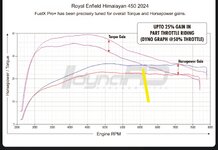
And I have no Idea what Ron is talking about and wonder if he does either
Torque and horse power cross at 5252rpm on a "Real" Dyno graph, this one has been altered to give the impression of an engines power output for the purpose of selling a product .
And I have no Idea what Ron is talking about and wonder if he does either
Your logic is flawed. Dont be upset its a common easy mistake to make.The graph is bs imo,
Torque and horse power cross at 5252rpm on a "Real" Dyno graph, this one has been altered to give the impression of an engines power output for the purpose of selling a product .
View attachment 2851
And I have no Idea what Ron is talking about and wonder if he does either
Here let me explain why.
Your assuming he is using lb-ft why ?. Because the unit of measure has conveniently been left out.
The three crossover constants, derived from the unit conversion factors:
5,252 RPM — lb-ft vs BHP (imperial)Comes from the fact that 1 HP = 33,000 ft-lbs of work per minute, and one revolution = 2π radians. Divide those out: 33,000 / (2π) = 5,252.
7,024 RPM — Nm vs PS (metric horsepower)PS (Pferdestärke) is the European metric horsepower = 0.7355 kW. The Nm/kW constant of 9,549 divided by 0.7355 gives 7,024. This is the crossover you'll see on any European or Japanese bike dyno chart that uses PS.
9,549 RPM — Nm vs kW (SI units)Comes from the SI definition: Power (W) = Torque (Nm) × Angular velocity (rad/s). Converting RPM to rad/s: RPM × 2π / 60 = RPM / 9.549. Rearranged: crossover at RPM = 9,549